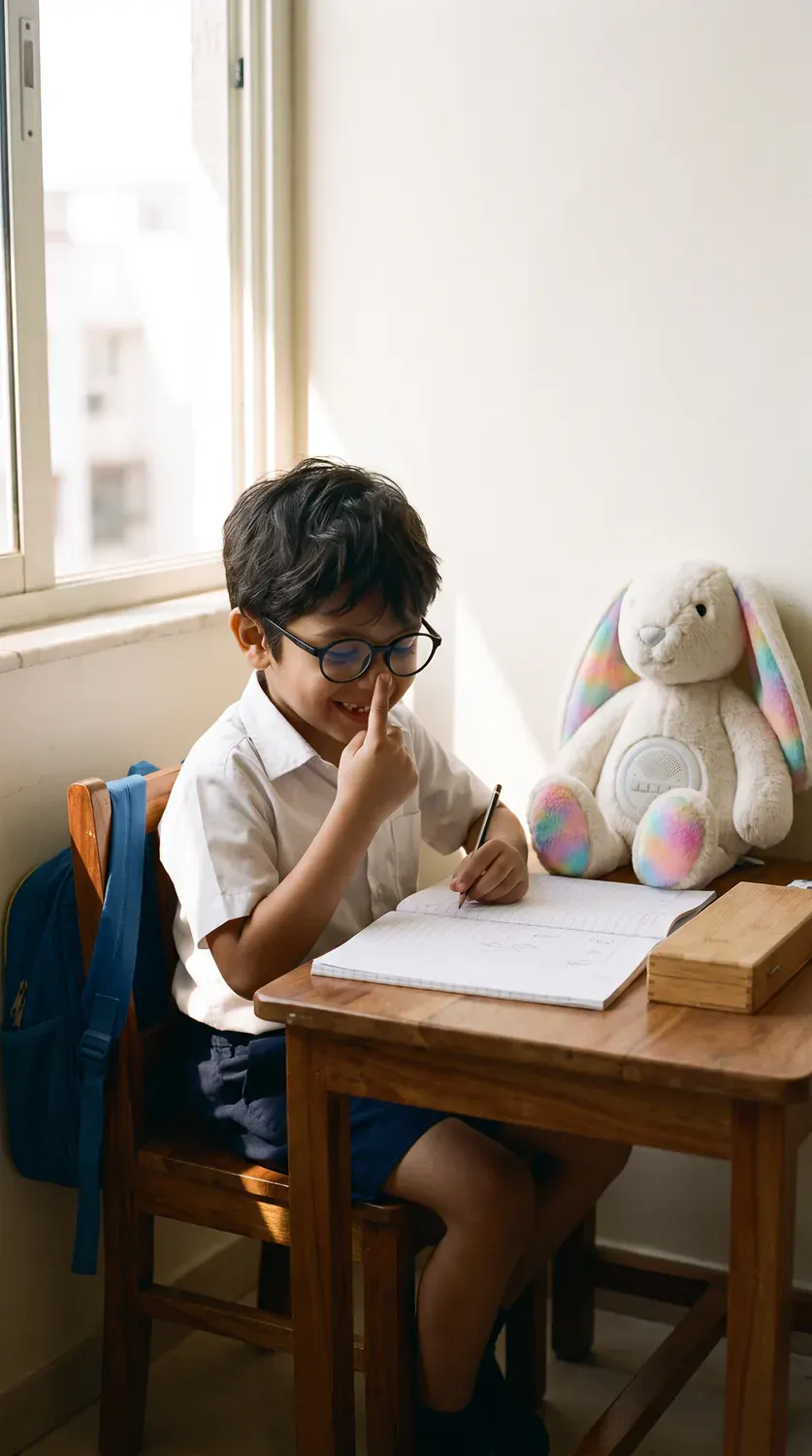
How screen time child sleep habits affect your nights
Understand how screens impact rest and how the 2026 IAP guidelines can help your family build calmer nights.
How do screens affect my child's sleep?
Screens emit blue light that suppresses melatonin, making it harder for children to fall asleep. Fast-paced content also stimulates their brains and raises their heart rate. The IAP and other bodies recommend stopping all screen use at least an hour before bedtime to protect their rest.
The link between screen time child sleep habits is something we feel long before we read the research. You notice it on a heavy monsoon afternoon when a tablet session runs too long. The house is quiet for an hour. You manage to finish folding the laundry and prep the dal. Then the evening turns into a sudden struggle of tired eyes and loud tantrums just before dinner.
Getting a young child to rest is hard enough without digital interference. The Indian Academy of Pediatrics released updated guidelines in 2026 to help families manage digital habits. They ask us to look at what devices replace in our daily routines.
When a child stares at a phone, they sit perfectly still but their mind is racing. This creates a gap between physical tiredness and mental readiness for bed. Understanding this gap helps us build evenings that actually end peacefully.
How screen time child sleep patterns affect your home
The light from our phones and televisions tricks the human brain. Electronic screens emit blue light. This specific wavelength interferes with melatonin. Melatonin is the hormone that tells the body the day is done and it is time to rest. A study in Japan found that melatonin levels dropped significantly in children exposed to bright screens before bed.
The Canadian Paediatric Society points out that this suppression delays sleep and disrupts the whole night. The child lies awake, staring at the ceiling fan, while their internal clock thinks the sun is still high in the sky. This delay means less total rest over the week.
When the alarm rings for the morning school run, they are completely exhausted. You end up dragging them out of bed, rushing through breakfast, and dealing with tears over a misplaced water bottle. The cycle of poor rest and difficult mornings repeats. It changes their mood for the entire day. A tired child struggles to manage small frustrations. They drop a crayon and burst into tears. They refuse to share a toy with a sibling. The root cause is often simply a lack of quality rest from the night before.
What the 2026 IAP guidelines say about digital habits
The Indian Academy of Pediatrics asks families to set clear boundaries. For children up to age five, they recommend a maximum of one hour of supervised screen use a day. For older children, it is under two hours.
The focus is never just on the clock. The guidelines state clearly that digital use must never replace sleep or physical play. A video call with a grandparent in Chennai is a shared experience. Handing over a phone simply because a child is bored while you wait at a restaurant is what they suggest we avoid. Boredom is often the push a child needs to invent a new game with a spoon and a napkin.
The academy also recommends keeping devices out of the bedroom entirely. A tablet charging on a bedside table is a constant temptation. It prevents the room from being a space dedicated only to rest. When the bedroom becomes an entertainment centre, the brain stops associating the bed with sleep. We need to protect their sleeping environment. Moving the charging cables to the living room is a simple fix. It sets a physical boundary that young children understand easily.
The mental stimulation of evening screens
Light is just one part of the problem. What they watch keeps them awake just as much. Fast-paced cartoons or loud interactive games raise the heart rate.
A review published on the National Center for Biotechnology Information website notes that this mental stimulation makes it much harder for children to wind down.
Their minds are racing with bright colours, sudden loud noises, and fast cuts. When we turn off the television and expect them to sleep ten minutes later, their brains are still processing all that digital noise.
This is why a sudden jump from a tablet session to the pillow rarely works. Children need time to transition from high alertness to a state of calm. Think of how you feel after watching an intense action movie late at night. You cannot simply close your eyes and drift off. A child's nervous system is even more sensitive. They need a bridge between the noise of the day and the quiet of the night. Without that bridge, you get bedtime battles. They will ask for water or complain about shadows on the wall. They are not trying to be difficult. Their bodies are just too wired to sleep.
Building a calmer bedtime routine
The best way to protect rest is to create a wide gap between the digital world and the pillow. Research hosted on the PubMed Central database advises keeping young children away from screens for at least an hour before sleep.
We can fill that hour with things that ground them in the real world. A warm bath works wonders. Reading a physical book together in dim light helps their eyes relax. Talking about what happened at school that day gives them a chance to process their emotions. These quiet moments signal to the nervous system that the day is completely done.
It takes practice to build this routine. Some nights will be harder than others. You might be exhausted from work and tempted to use the television to keep them quiet while you eat dinner. We all have those evenings. The goal is to make the screen-free hour the standard habit rather than a rigid rule. Keeping devices charging in the living room removes the temptation entirely. It gives the whole family a chance to disconnect. When parents also put their phones away, children notice. We set the tone for the house. A quiet home leads to a quiet mind.
Questions parents ask
Can a child watch a calm show before bed?
The light from the screen still suppresses melatonin, even if the story is gentle and the volume is low. It is far better to rely on physical books or audio stories in the hour before sleep.
What if my child wakes up in the middle of the night?
Keep the room completely dark and avoid turning on screens to soothe them. A phone screen will just wake their brain up further. If sleep problems continue over several weeks, talk to the paediatrician.
Do the rules change for video calls with family?
Most guidelines treat interactive family calls differently than passive watching. A chat with an aunt is a social connection. However, it is still wise to finish these calls well before bedtime so the child has time to wind down.
Try moving the phone charger out of the bedroom tonight. Replace the last screen session of the day with a simple board book or a quiet chat about their favourite part of the afternoon.
Written by Aman Soni. Say hello on Aman Soni’s LinkedIn.
The IAP guidelines suggest one hour for children up to age five, and under two hours for older children.
Sources
- [1]National Institutes of Health, “Associations Between Screen Time, Physical Activity, and Sleep Patterns in Children Aged 3–7 Years, A Multicentric Cohort Study in Urban Environment - PMC” https://pmc.ncbi.nlm.nih.gov/articles/PMC12031148/
- [2]National Institutes of Health, “Screen time and sleep in children - PMC” https://pmc.ncbi.nlm.nih.gov/articles/PMC11280700/